

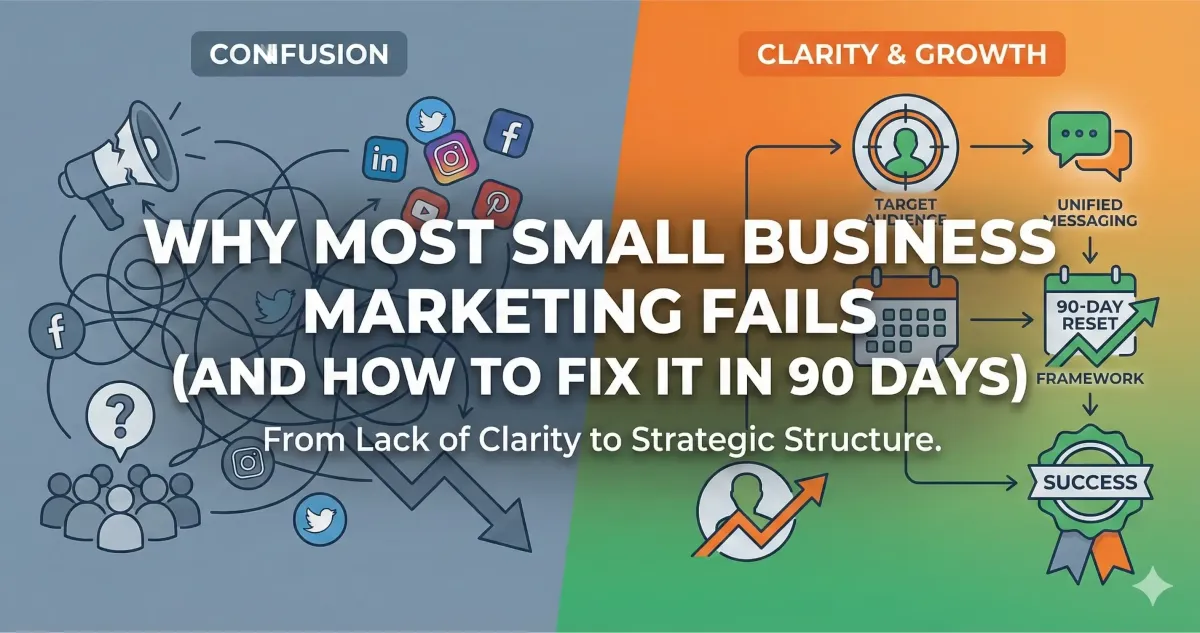
Why Most Small Business Marketing Fails (And How to Fix It in 90 Days)
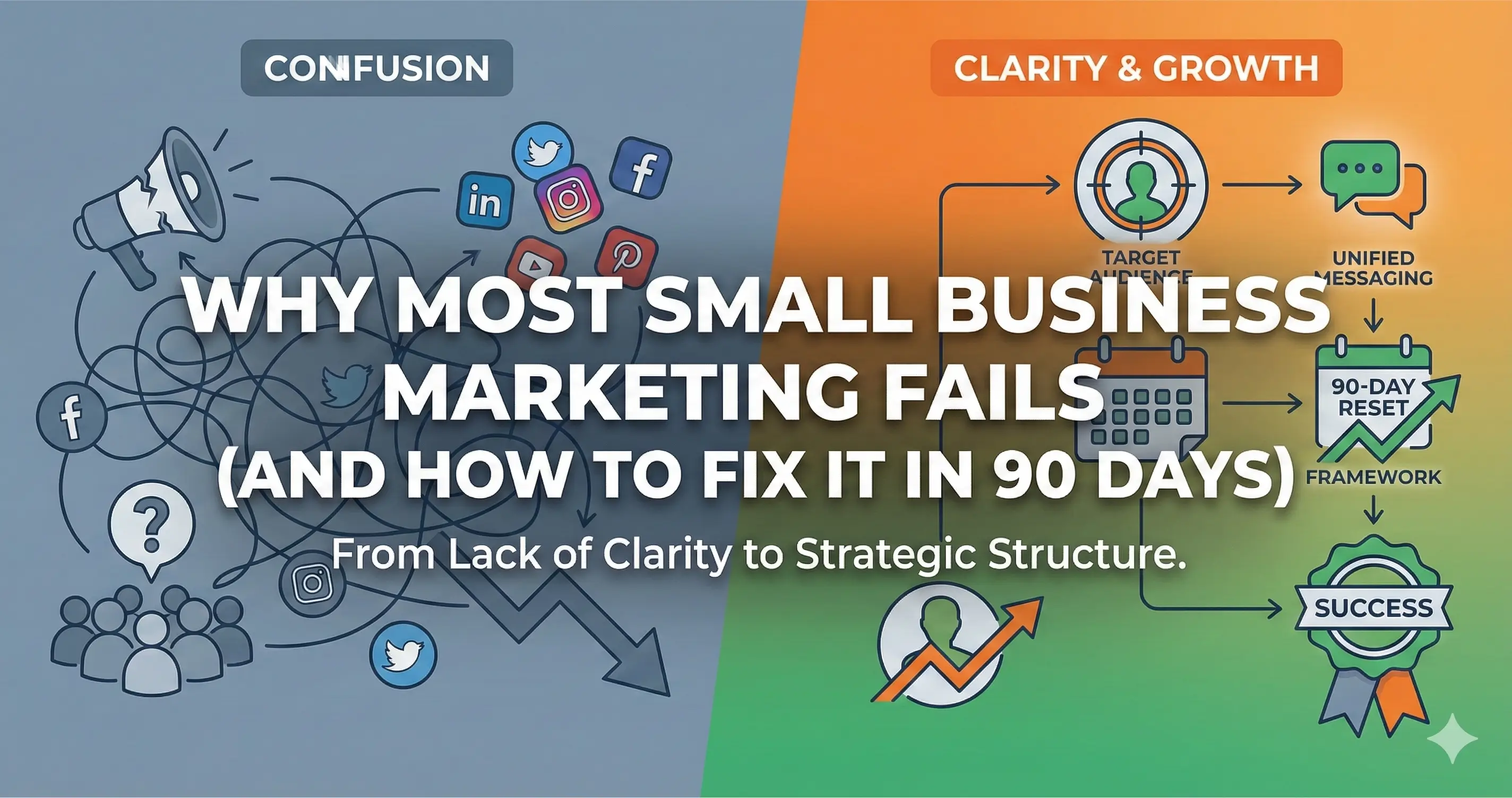
Why Most Small Business Marketing Fails (And How to Fix It in 90 Days)
Marketing failure rarely comes from lack of effort.
It comes from lack of clarity.
Every week I meet business owners who are posting daily, running ads, boosting content, trying new platforms — yet still struggling to generate consistent leads. The problem isn’t work ethic. It’s structure.
According to the U.S. Small Business Administration, one of the leading causes of early-stage business underperformance is poor market positioning and inconsistent strategy. Visibility without direction does not produce growth.
If you feel like your marketing is busy but not productive, this article will give you a 90-day reset framework.
The Real Reason Small Business Marketing Fails
Most marketing problems fall into three categories:
1. Undefined Customer Profile
If you market to everyone, you resonate with no one.
Many small businesses define their audience too broadly:
“Homeowners”
“Business owners”
“Families”
That isn’t a strategy. That’s a population.
Clear marketing starts with specificity:
What problem keeps them awake at night?
What outcome are they chasing?
What decision triggers their purchase?
Without that clarity, messaging becomes generic — and generic messaging does not convert.
2. Inconsistent Messaging
Inconsistency kills trust.
One week you’re educational.
The next week you’re promotional.
Then you disappear.
Consumers trust familiarity. Research from Nielsen consistently shows repeated exposure builds brand trust and recall.
Marketing must feel predictable in value, even if the format changes.
3. No Measurable Objective
If you cannot answer:
“How many qualified leads do we need this month?”
You do not have a marketing strategy. You have activity.
Growth requires measurable benchmarks:
Cost per lead
Conversion rate
Monthly revenue target
Follow-up timeline
Without metrics, you can’t improve.
The 90-Day Marketing Reset Framework
If your marketing feels scattered, here is the exact reset process I recommend.
Step 1: Clarify the Outcome (Week 1–2)
Instead of asking:
“How do we get more exposure?”
Ask:
“How many new clients do we need per month?”
Then reverse engineer:
Average sale value
Close rate
Required lead volume
Example:
If your average client is worth $2,000 and your close rate is 25%, you need 4 leads per sale.
If you want 10 new clients per month:
You need 40 qualified leads monthly.
Now marketing becomes mathematical — not emotional.
Step 2: Simplify Your Channel Focus (Week 2–4)
Most small businesses spread themselves thin across too many platforms.
Choose:
One primary attention channel (social or search)
One capture system (website landing page)
One nurture channel (email or SMS)
Focus beats fragmentation.
HubSpot research shows businesses that consistently publish blog content generate significantly more inbound leads over time than those who rely solely on paid promotion.
Depth beats randomness.
Step 3: Build a Lead Capture System (Week 3–6)
Visibility without capture is wasted attention.
You need:
A clear offer (audit, consultation, checklist, guide)
A simple landing page
Automated follow-up
Your system should answer:
“What happens immediately after someone shows interest?”
If the answer is “we’ll reach out eventually,” you’re losing opportunities.
Step 4: Implement Structured Follow-Up (Week 4–8)
Most leads don’t convert immediately.
According to multiple sales studies, consistent follow-up dramatically increases close rates.
Your follow-up should include:
Immediate confirmation
Educational email sequence
Personal touchpoint
Reminder cadence
Marketing works best when it combines automation with personal leadership.
Step 5: Measure and Optimize (Week 8–12)
Track:
Leads generated
Conversion rate
Revenue per lead
Content engagement
Cut what doesn’t work.
Double down on what does.
Marketing success rarely requires reinvention.
It requires refinement.
What Successful Small Businesses Do Differently
They:
Speak clearly to one audience.
Publish consistently.
Track real metrics.
Adjust based on data.
Treat marketing as a system — not a campaign.
Clarity compounds.
Frequently Asked Questions
What is the most important part of a small business marketing strategy?
Clear positioning and measurable goals. Without defined outcomes and a specific audience, even well-designed campaigns struggle.
How long does it take to fix a marketing strategy?
With focused execution, meaningful improvements can be seen within 90 days.
Should small businesses focus on organic or paid marketing?
Both can work. Organic builds long-term authority. Paid accelerates exposure. The key is structure and follow-up.
How many marketing channels should a small business use?
Start with one or two done exceptionally well before expanding.
Final Thought
Marketing is not about volume.
It is about precision.
If your marketing feels overwhelming, the solution is not more tactics.
It’s clarity, structure, and disciplined execution.
Build systems.
Measure outcomes.
Lead with value.
That’s how small businesses grow sustainably.
You Learned The Path, Now What?
Ready to get started? Get clarity and a plan by booking a complimentary Marketing Strategy Session here.