
Meta AI Update December 2025 | Business Advertising Changes
“This is Meta’s most aggressive attempt yet to monetize AI by turning private interactions into ad signals—a reminder that if a service is free, the user is the product.” - Gadjo Sevilla and Jeremy Goldman of EMARKETER
The Story:
Starting today—right now, in fact—Meta is fundamentally changing how it personalizes what you see and which ads you're shown across Facebook, Instagram, Messenger, and WhatsApp. This isn't a small feature tweak. It's a systemic shift in how one of the world's largest advertising platforms understands and targets your audience.
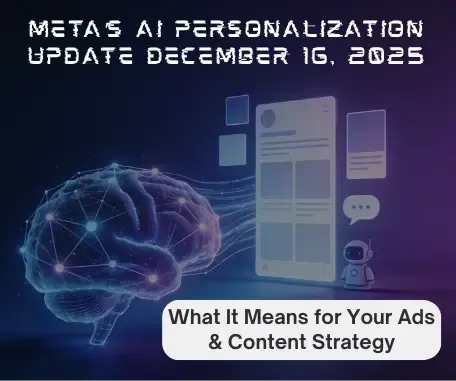
Here's what's happening: beginning today, December 16, 2025, Meta will use people's interactions with Meta AI—both text and voice conversations—as a new signal to personalize content and advertisements. If someone chats with Meta AI about hiking, they might later see posts from hiking groups, updates from friends about trails, or ads for hiking boots. This data point joins the existing collection of signals Meta already uses: likes, follows, comments, shares, and search history.
The rollout started in most regions today, with gradual expansion expected. The exception: the UK, EU, and South Korea—where regulatory requirements (particularly GDPR) made the rollout more complex.

Why This Matters to Your Business
If you run ads on Meta's platforms, you're already competing in an ecosystem shaped by algorithmic personalization. This update doesn't change that game—it amplifies it.
Here are four reasons this update matters for your marketing:
1. Your Audience Is Now More Predictable (And More Complex)
Meta now has a new dimension of data about what people areactively interested inthrough their AI conversations. Previously, Meta inferred interests from static behaviors (likes, posts, ads clicked). Now, they're capturing dynamic intent—what people are thinking about and asking about right now.
For your business, this is a double-edged sword:
The upside:If your product solves a problem someone just asked Meta AI about, Meta's algorithm can now connect those dots faster and more accurately. A tax preparation company could theoretically reach someone who just asked Meta AI about "deductions for small business owners"—before they even start searching Google.
The complexity:The playing field just got more sophisticated. Advertisers who rely on broad, demographic targeting will find their ads less effective. Advertisers with precise, intent-driven messaging will win. This puts pressure on your targeting strategy and creative quality.
2. Content Strategy Just Got Another Layer
This isn't just about paid ads—it's about organic reach too. The same AI-interaction signals Meta uses for personalization will influence what content appears in people's feeds. If your business creates content, this changes how people discover it.
What this means:Content that resonates with what people are actively discussing with Meta AI will have a better chance of appearing in feeds. If you're in fitness, and people are asking Meta AI about "home workouts for beginners," content around that topic will get a lift.
The implication: Understand what your audience is asking Meta AI. You can do this by:
Surveying your audience directly about their questions
Monitoring forums, Reddit, and Q&A sites where your audience hangs out
Reviewing customer support tickets and FAQs for real questions
Testing content that answers the actual questions people are asking AI
3. Privacy Concerns Are Real, But the Impact on Advertisers Is Minimal
Let's address the elephant in the room: Meta is collecting more data. Users are rightly concerned. Meta says it won't use conversations about sensitive topics—religion, sexual orientation, political views, health, or racial/ethnic origin—for ad targeting. Whether that's sufficient protection is a separate debate.
For your business: Meta is being more transparent than before. They've updated their privacy policy and are reminding users of changes. This is an opportunity for you to also be transparent with your customers about how you're using their data and how you're respecting their privacy. Brands that lead with privacy-first messaging will stand out.
4. AI Agents Will Soon Do This Targeting For You
Here's the longer play: Meta isn't just personalizing; they're preparing for agentic AI in advertising. Agentic AI means autonomous systems that make decisions and take actions without constant human input. By early 2026, Meta plans to launch tools where you can describe a product and a budget, and their AI agent will create and optimize entire campaigns automatically.
When that happens, Meta's personalization system—now powered by AI chat interactions—will be the intelligence behind those autonomous decisions. Your job will shift from "managing audiences" to "setting strategy and letting AI execute."
What you should do right now.
For social media managers and marketing teams:
Audit your Meta AI usage: If you or your team uses Meta AI, understand that your interactions will influence recommendations for content and ads. Be intentional about what you're asking.
Review your ad targeting strategy: Are you relying on broad demographic targeting, or are you testing audience-specific, intent-driven messaging? This update rewards the latter. Start A/B testing narrower, more specific audience segments with tighter messaging.
Map your audience's real questions: Document the top 20 questions your ideal customers are asking. Create content that answers them. Use those insights in your ad copy and landing pages.
Get ahead of organic reach changes: If you create organic content on Meta, analyze which pieces performed best over the last 90 days. Identify the topics and themes. Double down on those themes in the next quarter.
Prepare for agentic AI: If you're not already experimenting with AI-powered ad creation and optimization tools, start now. By mid-2026, the competitive advantage will go to teams that know how to workwithAI agents, not against them.
For business owners and executives:
Budget accordingly: Expect your ad costs to remain stable or slightly increase as competition for precise targeting intensifies. Allocate budget for testing new audience segments and messaging.
Prioritize customer intent data: Start collecting data about what your customersneedandask about. This can come from surveys, customer interviews, support tickets, or email inquiries. Use this to inform your ad strategy and content roadmap.
Monitor performance closely: Set up dashboards to track how your Meta ads perform post-December 16. Look for shifts in cost per lead, conversion rates, and ROAS by audience segment. Document what works and what doesn't.
Plan for agentic AI adoption: By Q3 2026, competitive advantage in Meta advertising will depend on how well you've organized your audience data, messaging, and product information for AI agents to work with. Start structuring this now.
The bigger picture.
This update is part of a larger pattern. Google has agentic AI in Search. OpenAI is building autonomous agents. Amazon and Alibaba are doing the same. The platforms aren't just personalizing anymore—they're automating the entire decision-making process around how ads are shown and content is distributed.
For business owners, the message is clear:static targeting and generic messaging are becoming obsolete. The next era of growth belongs to companies that can articulate their value proposition with precision, understand their customers' intent deeply, and be willing to experiment with how AI agents will represent their brand.
Meta's AI personalization update is a symptom of this shift. It's not something to fear or ignore. It's something to embrace strategically.
Sources & References
Meta Announces AI Personalization Update (Reuters, October 2025)
What Is the Meta AI Update December 16, 2025? (Memory KPR, November 2025)
Meta Reminds Users of AI Interactions Privacy Policy Change (Digital Information World, December 2025)
AI Update: Agentic AI in Marketing (Talkwalker, December 2025)
CMOs Who Move First in Agentic Marketing Will Win (BCG, November 2025)