

The New Default AI Model in Google Search: Gemini 3 Flash and Your Competitive Edge
“AI is the new electricity.” - Andrew Ng
What this is about:
Google just changed the AI game again, and if you're running a marketing agency, managing content, or relying on any AI tools for your business, you need to understand what this means for your bottom line.
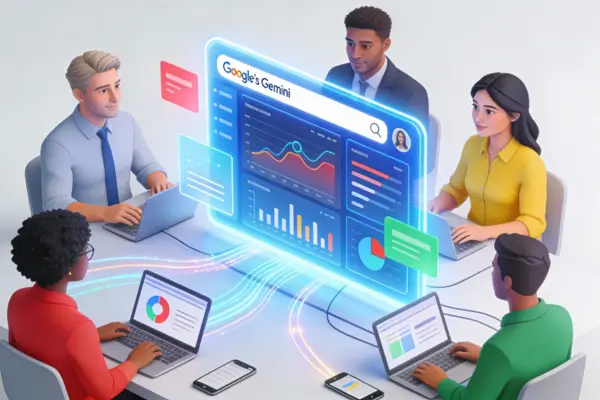
On December 17th, Google released Gemini 3 Flash, a speed-optimized version of its flagship Gemini 3 model. By itself, "new model release" might sound like tech noise. But here's what actually matters: this model is now the default across Gemini and built directly into Google Search's AI Mode—reaching billions of people instantly. And for businesses that rely on AI for productivity, cost, and competitive differentiation, this is a watershed moment.
What changed, and why it matters:
Gemini 3 Flash replaces Gemini 2.5 Flash across the board. On the surface, that's a routine upgrade. But the numbers tell a different story.
Google claims Gemini 3 Flash delivers frontier-class reasoning while running three times faster than its predecessor. More importantly, it uses significantly fewer tokens on average—which translates directly to lower API costs if you're building AI-powered workflows for your business.
The model matches Gemini 3 Pro on advanced benchmarks in reasoning, multimodal understanding, and knowledge tasks. This matters because Gemini 3 Pro was already a top-tier model. That means Google managed to deliver Pro-level intelligence at Flash speed and fraction-of-the-price efficiency.
Performance isn't the only shift. Google integrated Gemini 3 Flash into its search product on day one. For the first time in Google's history, a state-of-the-art model is shipping at scale through search itself. If you've noticed smarter, more conversational answers in Google's AI Mode, that's Gemini 3 Flash working on your searches right now.
Major platforms are already adopting it. Salesforce, Workday, and Figma—some of the world's most demanding enterprise software platforms—have begun deploying Gemini 3 Flash. That's not coincidence. That's signal that the model is production-ready and cost-competitive.
What This Means for Your Business
If you're managing a marketing team, running an agency, or leading sales operations, Gemini 3 Flash intersects your workflows in three critical ways:
First: Research and Content Acceleration
Your team spends time synthesizing information, identifying patterns, and drafting initial content. Gemini 3 Flash can handle these cognitive tasks—understanding complex documents, comparing data sets, drafting outlines—while running fast enough to fit into real-time workflows. Speed matters here because faster analysis means faster decision-making.
If you're currently using AI tools to support research, content brainstorming, or customer analysis, moving to a faster model doesn't just save time. It changes how you work. Tasks that felt too time-consuming for AI support become practical.
Second: Search Integration and SEO Visibility
Google Search is reshaping how people find information. AI Mode in Search now defaults to Gemini 3 Flash. That means the answers Google gives are smarter, more contextual, and increasingly based on real-time reasoning.
For SEO strategists, this is a reminder that search isn't just about keywords anymore. It's about how well your content answers complex questions and fits into real-time reasoning chains. If you're building content strategy, ask yourself: does your content answer the "why" and "how," not just the "what"? Gemini 3 Flash rewards that depth.
For e-commerce and service businesses, it's worth testing how your business information appears in AI-powered search results. That's becoming a new traffic channel.
Third: Cost Advantage in AI Workflows
If you've been hesitant about building AI into your operations because of token costs, Gemini 3 Flash lowers that barrier. More efficient tokens + faster execution = real cost savings at scale.
This is especially relevant if you're a small agency or bootstrapped business. The cost advantage of using Gemini 3 Flash over other frontier models is substantial. That changes the math on whether you can afford AI-powered customer support, content generation, or internal analysis workflows.
The Broader Picture: AI is Becoming Infrastructure
This release signals something deeper: AI is transitioning from a specialty tool to infrastructure—baked into the products you already use.
Five years ago, using cutting-edge AI required building custom integrations or subscribing to separate services. Today, it's built into Google Search, available through APIs at scale, and integrated by default into enterprise software like Salesforce and Workday.
That shift favors businesses that move quickly. Early adopters of these integrated tools gain efficiency and cost advantages. Laggards face increasing competitive pressure.
What to Do Now:
1. Test Gemini 3 Flash in your workflow today. If you use Gemini app or Google Search, you're already using it. Pay attention to speed and quality. Does it change how you'd use AI for research or drafting?
2. Audit your current AI spending. If you're using multiple AI tools, model costs might be a line item. Evaluate whether switching to more cost-efficient models changes your ROI calculation.
3. Reassess your content strategy for AI-powered search. If Google Search answers are becoming smarter and more contextual, your content strategy should reflect that. Depth, clarity, and thoroughness matter more than ever.
4. Consider integrating AI into workflows you've deferred. If cost or speed was the barrier to AI integration in customer service, content operations, or research, Gemini 3 Flash lowers that barrier.
The Reality Check
None of this means Gemini 3 Flash is perfect or that other models (Claude, GPT, Llama) stop mattering. It means Google has raised the baseline. If you're shopping for AI tools or considering AI integration, you now have a stronger, faster, cheaper option from the search giant that already owns your data.
For marketing professionals and business leaders, the takeaway is simple: the cost and capability barrier to AI productivity is falling fast. Staying competitive increasingly means staying current with these tools.
Google made AI faster, cheaper, and more accessible today. That changes what's possible tomorrow.
SOURCES / REFERENCES
Google Blog: "A new era of intelligence with Gemini 3" (November 17, 2025) —https://blog.google/products/gemini/gemini-3/
Business Standard: "Google rolls out Gemini 3 Flash for everyday tasks with improved reasoning" (December 17, 2025)
Axios: "Google Gemini 3 Flash is fast, cheap and everywhere. Here's what to know" (December 17, 2025)
Euronews Next: "From vibe coding to faster models: what's new in Google's Gemini update" (December 18, 2025)
CNBC: "Visa's AI agents automating hundreds of purchases for customers" (December 18, 2025)
Gemini API Documentation: "Release notes | Gemini API - Google AI for Developers" (December 17, 2025)
ET Edge Insights: "Akamai and Visa join forces to secure the next era of agentic commerce" (December 18, 2025)
Google AI Studio: Gemini API changelog showing Gemini 3 Flash deployment across platforms https://journals.chnu.edu.ua/mediaforum/article/view/885
FAQ: Gemini 3 Flash and Your Business
1. What is Gemini 3 Flash in simple terms?
Gemini 3 Flash is Google’s newest AI model that delivers Pro-level reasoning and multimodal understanding while running significantly faster than previous Gemini Flash versions. It is now the default model in the Gemini app and Google Search’s AI Mode, so many of your everyday searches and AI tasks are already powered by it.
2. How is Gemini 3 Flash different from Gemini 2.5 Flash or other models?
Compared to Gemini 2.5 Flash, Gemini 3 Flash offers frontier-class intelligence with up to roughly 3x faster responses and about 30 percent fewer tokens used on typical tasks, which improves both user experience and cost efficiency. Independent benchmarks also show it can match or beat larger “Pro” models on many reasoning and multimodal tests at a much lower effective cost.
3. Why should marketers and agencies care about this upgrade?
For marketers and agencies, Gemini 3 Flash means research, content drafting, and analysis workflows can run in near real time without the usual latency or price tag of top-tier models. That speed and efficiency let teams test more ideas, ship campaigns faster, and automate more “thinking” tasks without blowing up AI budgets.
4. How does Gemini 3 Flash change SEO and content strategy?
Because Gemini 3 Flash now powers Google’s AI Mode in Search, more users will see conversational, synthesized answers before they ever click a result. Content that clearly answers specific “how” and “why” questions and provides in-depth, structured explanations is more likely to be cited or surfaced in these AI-generated summaries.
5. What does this mean for my AI costs and ROI?
Gemini 3 Flash is designed for high-frequency, production workloads, using fewer tokens and returning results faster than many competing frontier models. For small agencies and lean teams, that token efficiency can translate into meaningfully lower AI spend per project and a stronger ROI on AI-powered workflows like customer support, analysis, and content generation.
6. Are other businesses actually using Gemini 3 Flash yet?
Yes. Enterprise platforms like Salesforce, Workday, and Figma are already using Gemini 3 Flash to power in-product AI features, which signals that the model is stable and production-ready. Early adopters report gains in speed and scalability for tasks like design assistance, analytics, and agentic workflows, not just simple text generation.
7. What are the first practical steps I should take after reading this?
Start by testing Gemini 3 Flash in the Gemini app or your existing Google Cloud / Vertex AI setup to compare speed and quality against what you use today. Then review your AI spend and content strategy to see where a faster, more cost-efficient model could let you automate deferred workflows or deepen the content you create for AI-powered search.