
AI Addiction, Compliance, and Trust: What China's New Chatbot Rules Tell Us About the Future
“Efficiency is doing things right; effectiveness is doing the right things.” - Peter F. Drucker

What this is about:
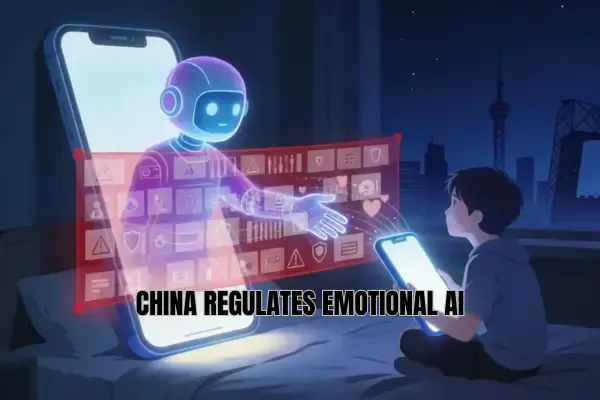
On December 27, 2025, China's cyber regulator released draft rules that signal a fundamental shift in how the world will regulate artificial intelligence. These aren't theoretical guidelines, they're the first regulatory body imposing strict oversight on "emotional AI": AI systems designed to mimic human personality, think like humans, and form emotional bonds with users.
For business owners, entrepreneurs, and marketing teams, this matters immediately. China doesn't regulate in a vacuum. What happens there ripples globally.
Here's what just changed, why it matters, and how to prepare.
What China's New AI Rules Actually Say
The draft regulations target AI products that simulate human-like interaction... think AI chatbots that feel like talking to a real person, AI companions that build emotional connection, or conversational agents designed to feel natural and relatable.
Under the new Chinese framework, AI providers must:
Warn users against excessive use.Providers can't stay silent when someone is overusing the service.
Actively intervene on addiction.If the system detects signs of dependency, addiction, or extreme emotional states, providers must take action to stop it.
Monitor emotional states and psychological risk.Providers must assess user emotions, dependency levels, and wellbeing—essentially, providers now carry responsibility for psychological safety.
Implement safety throughout the product lifecycle.Algorithm review, data security, and information protection aren't optional—they're mandatory from day one.
Block dangerous content. Services must not generate content that endangers national security, spreads misinformation, promotes violence, or crosses into obscenity.
Notably, this regulation extends beyond chatbots. It applies to any AI service available to the public in China that presents simulated human personality traits, thinking patterns, or communication styles—whether through text, images, audio, or video.
Why This Matters Now
This is the first major government body explicitly regulating the psychological and emotional dimensions of AI—not just the technology itself, but the relationship it creates with humans.
Two forces collide here: the explosion of AI agents in marketing and customer service (growing at 45.8% annually, outpacing traditional marketing automation by 3.5x), and the growing concern about how AI can manipulate, addict, or psychologically harm users.
China's move is not isolated. California has already passed SB 243, which requires AI companion providers to prevent conversations involving suicide, self-harm, or sexually explicit content—starting in 2026. The European Union has been regulating AI safety and transparency for over a year. India, Brazil, and others are following.
The pattern is clear: Emotional AI is getting regulated. Period.
The AI Agents Revolution (And What It Means for Your Marketing)
While China regulates, the marketing world is being transformed by agentic AI, autonomous systems that build campaigns, personalize messages, and optimize strategies without waiting for human approval.
In 2025, AI agents moved from being helpful tools to becoming core strategic partners in B2B marketing and sales. Companies like 6sense, Salesloft, and newer platforms have deployed AI agents that:
Build and route campaigns autonomously
Sequence actions and reinforce quality control
Adjust performance levers in real-time
Identify buying signals and activate engagement at scale
Generate personalized content for thousands of prospects simultaneously
The efficiency gains are staggering. Teams are completing work that used to take weeks in days. Prototyping is 10x faster. Software engineering is 50% faster (according to Andrew Ng at AI Dev 25 x NYC in December 2025).
But here's the tension: The faster AI agents move, the more responsibility falls on companies to use them ethically.
If your AI marketing agent is personalizing messages to exploit psychological triggers, building emotional attachment to your brand, or manipulating customers at scale, China's regulations would consider that a violation. And other countries will follow.
What Business Owners Should Do Now (Before the Rules Catch Up)
1. Audit your AI systems for "emotional design."
If you're using AI to build customer relationships, ask: Are we designing for genuine value or emotional manipulation? Are we creating dependency or empowerment? The difference matters—and it's becoming legally relevant.
2. Implement transparency into your AI systems.
Tell customers when they're talking to an AI. Be clear about what data you're collecting and how you'll use it. This isn't just regulatory protection, it's trust-building.
3. Consider the psychological impact of your AI tools.
If your chatbot is designed to feel like a friend, a therapist, or a trusted advisor, you now have a responsibility to that person's wellbeing. That's not just ethics, it's increasingly the law.
4. Prepare for similar regulations in your market.
China is first, but the U.S., Europe, and other major markets will follow. The smart move: Build for the strictest market you serve. If you build compliant for China and the EU, you'll be ahead of the curve everywhere else.
5. Shift from automation-first to responsibility-first thinking.
In 2025, the bottleneck wasn't technology, it was ethics. The companies winning in 2026 will be those that deploy AI agents with speed but also with clarity about impact.
The Opportunity Hidden in the Regulation
Here's the counterintuitive part: Regulation is a competitive advantage for ethical companies.
When China, the EU, and eventually the U.S. regulate emotional AI, companies that have already built trust, transparency, and responsible AI into their systems will have an edge. You'll be ahead of compliance. You'll have customer trust. You'll be the brand peoplechooseto use.
Companies that built for speed alone will have to rebuild. That's expensive and painful.
The smarter path: Build AI systems that are fast, effective,andtransparent about what they're doing. Treat user psychology with the same rigor you treat user data. Monitor for unintended consequences. Intervene when something feels off.
This isn't just regulatory preparedness. It's competitive strategy.
What's Coming in 2026
Expect a wave of regulation on emotional AI, chatbot ethics, and AI agent accountability in the first half of 2026. California's SB 243 kicked in January 1, 2026. China's rules are in public comment now. The EU will likely strengthen existing frameworks.
For your business, the timeline is tight but not impossible:
Now (January 2026): Audit existing AI systems. Identify emotional AI and high-risk applications.
Q1 2026: Implement transparency, consent, and safety monitoring. Update terms of service.
Q2 2026: Monitor emerging regulations in your market. Adjust AI strategies if needed.
Ongoing: Keep monitoring new guidance and regulatory shifts. This landscape is moving fast.
The Bottom Line
China's new AI regulation isn't a warning, it's a map. It shows where regulation is heading globally. The companies that treat it as a roadmap rather than a threat will be the ones thriving in 2026.
Your AI agents can still be powerful, fast, and autonomous. They just can't be opaque about it. They can't exploit psychology. They can't ignore impact.
That's not a limitation. That's the future of AI that people actually trust.
Sources & References
China issues draft rules to regulate AI with human-like interaction – Reuters
https://www.reuters.com/world/asia-pacific/china-issues-drafts-rules-regulate-ai-with-human-like-interaction-2025-12-27/China issues draft rules to regulate AI with human-like interaction – Arizona Digital Free Press
https://arizonadigitalfreepress.com/china-issues-draft-rules-to-regulate-ai-with-human-like-interaction/China Issues Draft Rules To Regulate Human-Like AI Systems – NDTV
https://www.ndtv.com/world-news/china-issues-draft-rules-to-regulate-human-like-ai-systems-10039681China proposes rules to combat AI companion addiction – The Decoder
https://the-decoder.com/china-proposes-rules-to-combat-ai-companion-addiction/China targets human-like AI systems with new draft regulations – The News
https://www.thenews.com.pk/latest/1386315-china-targets-human-like-ai-systems-with-new-draft-regulationsChina Issues Draft Rules to Regulate AI With Human-Like Interaction – World Energy
https://www.world-energy.org/article/54907.htmlChina Proposes Rules on AI Companion Apps to Curb Addiction – Caixin Global
https://www.caixinglobal.com/2025-12-29/china-proposes-limits-on-ai-companion-apps-to-curb-addiction-102398347.htmlChina Issues Draft Rules to Govern Use of Human-Like AI Systems – Insurance Journal
https://www.insurancejournal.com/news/international/2025/12/29/852475.htmChina proposes draft rules to regulate human-like AI systems – Seeking Alpha
https://seekingalpha.com/news/4535578-china-proposes-draft-rules-to-regulate-human-like-ai-systemsWhat’s in China’s first drafts rules to regulate AI companion addiction? – Geopolitechs
https://www.geopolitechs.org/p/whats-in-chinas-first-drafts-rulesChina plans rules to protect children and tackle suicide risks – BBC
https://www.bbc.com/news/articles/c8dydlmenvroChina drafts world’s strictest rules to end AI‑encouraged suicide and violence – Ars Technica
https://arstechnica.com/tech-policy/2025/12/china-drafts-worlds-strictest-rules-to-end-ai-encouraged-suicide-violence/Provisional Measures on the Administration of Human‑like Interactive Services Utilizing Artificial Intelligence (draft, translation) – China Law Translate
https://www.chinalawtranslate.com/en/chatbot-measures-draft/China to crack down on AI chatbots around suicide, gambling – CNBC
https://www.cnbc.com/2025/12/29/china-ai-chatbot-rules-emotional-influence-suicide-gambling-zai-minimax-talkie-xingye-zhipu.htmlAI Agents in Marketing – IBM
https://www.ibm.com/think/topics/ai-agents-in-marketingAI Agents Revolutionized B2B Marketing in 2025: From Automation to Strategy – Demand Gen Report
https://www.demandgenreport.com/industry-news/feature/ai-agents-revolutionize-b2b-marketing-in-2025-from-automation-to-strategy/AI agents vs marketing automation – Pendula
https://www.pendula.com/blog/ai-agents-vs-marketing-automationChina releases ‘AI Plus’ plan, rolls out AI labeling law – IAPP
https://iapp.org/news/a/china-releases-ai-plus-plan-rolls-out-ai-labeling-lawAndrew Ng: Opening Keynote – AI Dev 25 x NYC (video) – DeepLearning.AI
https://www.youtube.com/watch?v=6ejKX20es3oAndrew Ng says AI is ‘limited,’ won’t replace humans anytime soon – NBC News
https://www.nbcnews.com/tech/innovation/andrew-ng-says-ai-limited-wont-replace-humans-anytime-soon-rcna246074The Top 5 Things That Happened in the AI Race This Year – Business Insider
https://www.businessinsider.com/what-happened-in-ai-this-year-2025-12
Beefy Marketing Resources
Beefy Marketing Blog
https://beefymarketing.com/blog/Beefy Marketing Resources
https://beefymarketing.com/resources/
FAQs - Emotional AI, Chatbot Regulations, and AI Agents for Business
1. What are China’s new rules on emotional AI and human‑like chatbots?
China’s draft rules target AI services that simulate human personality or emotions and interact with users through text, voice, images, or video. These systems must avoid emotional manipulation, suicide encouragement, and harmful content, and must add safeguards like human takeover in high‑risk situations.
2. Why should small businesses outside China care about these AI regulations?
Even if a business does not operate in China, these rules signal where global regulation is headed on emotional AI and chatbots. Similar laws are already emerging in places like California, which is targeting companion AI and mental health risks. Preparing now helps businesses stay ahead of compliance and build long‑term customer trust.
3. How do emotional AI regulations affect my marketing chatbot or AI assistant?
If a chatbot tries to build emotional closeness, offers mental‑health‑like support, or nudges users into decisions, it may fall into “emotional AI” territory. That means regulators can require clear disclosures, usage reminders, and safety protocols to prevent harm or addiction, especially for minors.
4. What is the difference between a basic chatbot and an AI marketing agent?
A basic chatbot typically answers questions based on scripts or narrow logic, while an AI agent can pull data from your CRM, analytics, and ad accounts, then decide and act on campaigns more autonomously. AI agents can optimize bids, send personalized messages, and adjust campaigns in real time with minimal human micromanagement.
5. Are AI marketing agents replacing traditional marketing automation tools?
AI agents are not replacing automation overnight, but they are rapidly extending and outperforming traditional rule‑based systems. Many 2025–2026 tools layer agents on top of existing platforms, using them to orchestrate journeys, analyze behavior, and trigger actions far beyond simple “if‑this‑then‑that” flows.
6. How can my business use AI agents in marketing without violating new or upcoming rules?
Businesses can stay compliant by clearly disclosing when users interact with AI, limiting emotional manipulation, and adding human review for sensitive topics like mental health, self‑harm, or gambling. Building in consent, data protection, and break reminders also aligns with both China’s proposals and emerging Western regulations.
7. Will emotional AI and chatbots face more regulation in the US and Europe?
Yes, the trend is toward stricter oversight of AI that influences emotions, especially for minors. California’s SB 243 targets companion AI safety, and broader AI bills in the US and EU are expanding transparency, accountability, and mental‑health protections for AI systems.
8. What are the biggest risks of emotional AI for brands?
Key risks include exploiting vulnerable users, creating psychological dependency, mishandling crisis conversations, and training on sensitive interaction data without clear consent. These risks can lead to reputational damage, legal exposure, and loss of customer trust if not proactively managed.
9. How can I tell if my current AI tools might be considered “emotional AI”?
Tools likely fall into that category if they:
Present themselves as a friend, therapist, or romantic partner
Simulate empathy or care as a core feature
Encourage long, frequent, or late‑night conversations
Nudge users on life decisions beyond simple product recommendations
If any of these apply, your tool will probably face higher regulatory expectations.
10. What practical steps should business owners take right now to prepare for AI regulation?
Owners should map where AI touches customers, label any emotional or human‑like use cases, and add disclosures and escalation paths to human support. Reviewing data practices, setting internal AI ethics guidelines, and partnering with trusted vendors puts the business ahead of inevitable compliance deadlines.
11. How does regulating emotional AI create opportunity for ethical brands?
Regulation tends to squeeze out low‑quality, manipulative tools and reward brands that build transparent, safe, and user‑respecting AI experiences. Companies that align early with emotional safety standards can use that trust as a differentiator in crowded markets.
12. What’s the best way to start using AI agents in my marketing if I’m a small business?
The best path is to start with one clear use case—like lead nurturing or abandoned cart follow‑up—then connect the agent to your CRM and analytics so it has context. From there, measure impact, introduce human review for edge cases, and expand use as you build confidence and clear guardrails.