
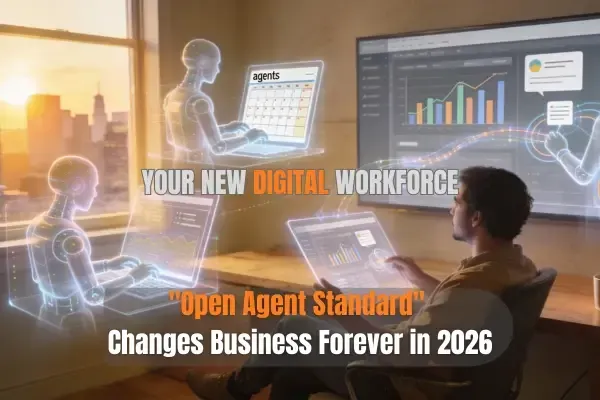
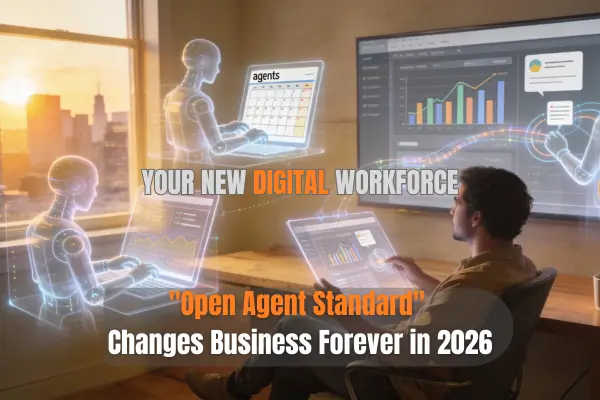
Your New Digital Workforce: Why the "Open Agent Standard" Changes Business Forever in 2026
“The first rule of any technology used in a business is that automation applied to an efficient operation will magnify the efficiency. The second is that automation applied to an inefficient operation will magnify the inefficiency.” - Bill Gates, American Businessman and Philanthropist
What this is about:
Your business in 2026 should not run the way it did in 2023–2025. The Open Agent Standard has quietly turned AI from a smart assistant into a reusable, portable digital workforce that can follow your processes, not just answer your questions.
The Story From Chatbot Era to Agent Era:
The last few years were about asking AI for help and then doing the real work yourself.
In 2026, the game has changed: agentic AI systems can now carry out multi-step tasks across your tools with minimal supervision.
Anthropic’s Agent Skills standard lets you define repeatable “skills” (like qualify leads or prepare a weekly report) that agents can reuse across different platforms.
Open adoption and related frameworks mean these skills are becoming interoperable, not locked to one vendor.
If you’re still treating AI as a smarter Google search, you’re under-using what 2026 now makes possible.
What Should Be Different in Your Business in 2026?
In 2026, your competitive advantage is no longer whether you use AI, but how deeply and systematically you deploy agents into your operations.
Here’s what should look different:
You have named “digital roles,” not random tools
Instead of “we use AI sometimes,” your org chart should include roles like “AI Research Analyst,” “AI Sales Development Rep,” and “AI Marketing Coordinator” – each implemented as an agent with a clear scope.
Your SOPs are written for humans and agents
Any process you repeat weekly should exist as a step-by-step workflow that an agent can follow: inputs, tools to use, decision rules, and outputs.
You measure work in outcomes, not hours
Because agents can run 24/7, you should be tracking “reports generated,” “leads qualified,” or “tickets resolved,” not just “time spent.”
3 Concrete Ways to Restructure Around Agents in 2026
1. Turn SOPs into Agent Skills
Start with one area: marketing, sales, or operations.
Pick a task you do every week (e.g., “prepare weekly marketing performance report”).
Break it into precise steps: pull data from source A, compare against goal B, flag items below threshold C, send summary to team.
Use an agentic platform that supportsskills(Claude with Agent Skills or other agent frameworks) to encode that process as a reusable skill.
In 2026, this skill is no longer stuck in one place—it can be reused across compatible tools that speak the same standard.
2. Build an Agent-First Marketing & Sales Funnel
Stop thinking “add AI to my funnel” and start thinking “design the funnel around agents.”
For example:
Top of funnel: An agent monitors social and search trends, suggests content topics, and drafts posts and emails automatically.
Middle of funnel: An agent enriches new leads (industry, company size, recent activity) and scores them before a human ever gets involved.
Bottom of funnel: An agent preps proposals by pulling past work, case studies, and pricing templates into a draft for you to approve.
Your human team then focuses on high-stakes conversations and relationships, not the legwork.
3. Redesign Your Tech Stack Around Integration, Not Features
In 2026, the best tool is often the one that plays nicest with agents, not the one with the longest feature checklist.
Prioritize CRMs, project tools, and marketing platforms that expose APIs or native “agent” integrations.
Ask vendors directly: “How will AI agents be able to read, write, and update data in your system?”
Plan for a world where one agent spansmultipleapps, orchestrating your workflows instead of you being the glue.
What You Should Do This Quarter
To make 2026 materially different for your business, set three priorities for this quarter:
Choose one department to “agent-ify” first (marketing, sales, ops, or customer service).
Document 3–5 high-impact, repeatable workflows in that department and turn them into clear, step-by-step SOPs.
Implement at least one of those SOPs as an AI agent skill, running it in production alongside your team and measuring the results.
The businesses that win in 2026 will be the ones that stop treating AI as a novelty and start treating agents as staff—with defined roles, clear processes, and measurable outcomes.
Sources & References
Anthropic. “Equipping agents for the real world with Agent Skills.” Anthropic Engineering Blog, 15 Oct 2025.
https://www.anthropic.com/engineering/equipping-agents-for-the-real-world-with-agent-skillsAnthropic. “Donating the Model Context Protocol and establishing the Agentic AI Foundation.” Anthropic Newsroom, 8 Dec 2025.
https://www.anthropic.com/news/donating-the-model-context-protocol-and-establishing-of-the-agentic-ai-foundationVentureBeat. “Anthropic launches enterprise ‘Agent Skills’ and opens the standard.” 18 Dec 2025.
https://venturebeat.com/technology/anthropic-launches-enterprise-agent-skills-and-opens-the-standardThe Decoder. “Anthropic publishes Agent Skills as an open standard for AI platforms.” 18 Dec 2025.
https://the-decoder.com/anthropic-publishes-agent-skills-as-an-open-standard-for-ai-platformsOpenTools.ai. “Anthropic Introduces ‘Agent Skills’ as Open AI Standard: A New Era of Cross-Platform Portability.” 18 Dec 2025.
https://opentools.ai/news/anthropic-introduces-agent-skills-as-open-ai-standard-a-new-era-of-cross-platform-portabilityDeloitte Insights. “The agentic reality check: Preparing for a silicon-based workforce.” Tech Trends 2026, 23 Dec 2025.
https://www.deloitte.com/us/en/insights/topics/technology-management/tech-trends/2026/agentic-ai-strategy.htmlIBM. “The trends that will shape AI and tech in 2026.” IBM Think, 31 Dec 2025.
https://www.ibm.com/think/news/ai-tech-trends-predictions-2026WebProNews. “AI Reshapes Business in 2026: Agentic Systems Drive Efficiency.” 1 Jan 2026.
https://www.webpronews.com/ai-reshapes-business-in-2026-agentic-systems-drive-efficiencyPanthsoftech. “Agentic AI in 2026: How Autonomous Agents Transform Workflows.” 30 Dec 2025.
https://www.panthsoftech.com/agentic-ai-in-2026-autonomous-agents-workflowsKellton. “Agentic AI trends 2026: Future of agentic AI innovations.” 22 Dec 2025.
https://www.kellton.com/kellton-tech-blog/agentic-ai-trends-2026Auxis. “2026 AI and Agentic Automation Trends.” 23 Nov 2025.
https://www.auxis.com/whitepapers-guides/2026-ai-and-agentic-automation-trendsIDC. “Innovation at the core: How agentic AI will redefine business growth.” 10 Dec 2025.
https://www.idc.com/resource-center/blog/innovation-at-the-core-how-agentic-ai-will-redefine-business-growthBlue Prism. “Future of AI Agents: Top Trends in 2026.” 15 Dec 2025.
https://www.blueprism.com/resources/blog/future-ai-agents-trendsBernard Marr. “5 Amazing AI Agent Use Cases That Will Transform Any Business In 2026.” LinkedIn, 14 Dec 2025.
https://www.linkedin.com/pulse/5-amazing-ai-agent-use-cases-transform-any-business-2026-bernard-marr-5xezeHarvard Business Review. “AI Won’t Replace Humans — But Humans With AI Will Replace Humans Without AI.” 3 Aug 2023.
https://hbr.org/2023/08/ai-wont-replace-humans-but-humans-with-ai-will-replace-humans-without-ai
FAQs Your New Digital Workforce in 2026
1. What is the Open Agent Standard in AI?
The Open Agent Standard is a shared way for AI platforms to describe “skills” or tasks so that different AI agents and tools can understand and reuse them across systems.
2. How is an AI agent different from a chatbot?
A chatbot mainly answers questions in a conversation, while an AI agent can follow multi-step instructions, use your tools, and complete tasks like research, data entry, or reporting with minimal supervision.
3. Why does the Open Agent Standard matter for small businesses in 2026?
It matters because it lets you build repeatable AI “skills” once and use them across multiple platforms, reducing vendor lock-in and making your automation more flexible and future-proof.
4. How can my business start using AI agents right now?
Start by picking one repetitive workflow, writing it as a clear step-by-step process, and then implementing it as an AI agent skill in a platform that supports agents and integrations with your existing tools.
5. What business processes are best suited for AI agents?
Processes that are digital, repetitive, and rules-based—like lead qualification, reporting, research, customer service triage, and routine marketing tasks—are ideal starting points for AI agents.
6. Will AI agents replace my team in 2026?
AI agents are more likely to replacetasksthan people; they handle the busy work so your team can focus on strategy, creativity, and relationships, which is where humans still have the advantage.
7. How do I prepare my team to work with AI agents?
Teach your team to document processes clearly, think in workflows, and treat agents like digital coworkers that need good instructions, feedback, and oversight to perform at their best.
8. What skills should business owners develop to succeed with AI agents?
Owners should get comfortable with process mapping, basic data literacy, and prompt design, plus the ability to choose tools that integrate well with AI agents and expose APIs or automation hooks.
9. How do AI agents connect to my CRM, email, and other tools?
Most agent platforms connect through APIs, native integrations, or automation services, allowing agents to read and write data in your CRM, send emails, update tickets, and move information between systems.
10. How can I measure the ROI of AI agents in my business?
Track before-and-after metrics like hours saved, number of tasks completed, leads qualified, tickets resolved, and revenue influenced, then compare those gains to your spend on AI tools and implementation.