

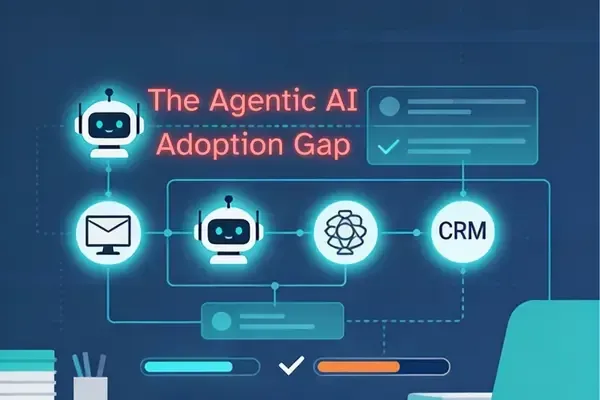
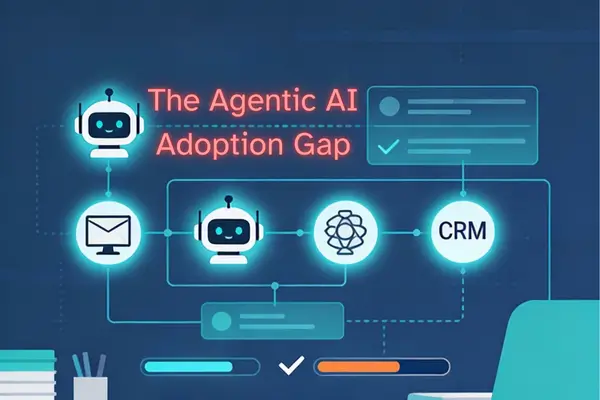
The Agentic AI Adoption Gap: Why Most Companies Are Stuck in Pilot Purgatory
“Last year was the year of experimentation and exploration for enterprises. They need to scale that impact and maximize their ROI of generative AI. Agents are the ticket to making that happen.” - Maryam Ashoori, Director of Product Management for AI at IBM
What this is about:
There's a massive disconnect happening right now in enterprise AI adoption—and it's costing businesses millions.
Three-quarters of companies have deployed AI agents in some capacity. Impressive, right? Except here's the catch: only 11% actually have agentic AI systems running in production. The rest are stuck in pilot purgatory—running tests that never turn into real business impact.
This gap isn't a technology problem. It's a strategy problem. And if you're a business owner or marketer trying to figure out whether agentic AI is worth your attention, this disconnect matters more than any new model announcement.
The Pilot-to-Production Crisis Is Real
The numbers tell a stark story. According to Deloitte's 2025 Tech Trends report, while 30% of organizations are actively exploring agentic AI, only 11% have deployed these systems into actual production environments. Meanwhile, PagerDuty's research found that 75% of companies have deployed AI agents "in some capacity"—a phrase that often means "we're running one test that nobody's sure about."
This is classic enterprise behavior: excitement about technology followed by the hard reality of actually implementing it at scale.
The culprits? According to eMarketer's recent analysis, foundational challenges are blocking the path to clear ROI. Companies are struggling with data quality governance, security frameworks, and the lack of a coherent strategy for integrating agents into their existing workflows.
In other words, the tools exist. The capability exists. What's missing is clarity on how to actually use them in ways that drive revenue.
Where Most Companies Are Getting It Wrong:
The problem starts with expectations. Agentic AI isn't like implementing new software; where you buy it, train users, and start seeing results. These systems require foundational work that many organizations haven't done yet.
Executives are allocating budgets (43% of enterprise AI budgets are now earmarked for agentic AI initiatives, according to Multimodal.dev), but without a clear roadmap, that spending produces pilot projects instead of business transformation.
The real blockers aren't technical:
Data Quality: Agentic systems are only as good as the data they're working with. Most enterprises lack the governance structures to ensure clean, reliable data streams.
Security & Governance: Organizations worry about giving AI systems autonomous decision-making power—and rightfully so. The gap between what enterprises can control and what they're willing to let AI handle independently is still wide.
Strategy Gaps: Many companies approach agentic AI the same way they did chatbots—by asking "What if we added AI to this task?" instead of asking "What if we designed this workflow around what AI can do?"
Companies like Fujitsu have cracked this code, reducing sales proposal time by 60% using specialized agents that handle data analysis, research, and document creation. But Fujitsu didn't start by deploying agents everywhere. They started with a specific, well-defined workflow and built from there.
What Production-Grade Agentic AI Actually Looks Like
When companies move beyond pilots and into production, three things change:
1. They Start Small and Specific
Successful implementations focus on high-volume, repetitive workflows where AI can deliver immediate, measurable ROI. This isn't about replacing all your knowledge workers. It's about automating the work that's stealing focus from strategic thinking.
At Capital One and other financial services firms, agentic AI is handling routine customer service interactions—freeing human agents to focus on complex problem-solving. The result: faster resolution, happier customers, and lower operational costs.
2. They Build Security and Governance Into the Design
Rather than bolting on compliance after the fact, companies moving to production define governance from day one. This means clear audit trails, human oversight at critical decision points, and explicit guardrails around what the AI can and cannot do.
Tools like those from Anaconda and other enterprise AI platforms are now VPC-first (Virtual Private Cloud), allowing organizations to keep AI workloads inside their own secure infrastructure. This shift signals that enterprises are moving from "Can we do this?" to "Can we do this safely?"
3. They Measure Real Business Outcomes
Pilots measure technical metrics. Production deployments measure actual ROI: reduced handle time, faster lead-to-conversion cycles, lower operational costs, improved customer satisfaction.
McKinsey's research suggests that agentic AI could unlock an additional $2.6 to $4.4 trillion in economic value across industries. But that value only accrues to companies that actually move beyond experimentation into scaled implementation.
The Gap Is Narrowing—But Slowly
By 2028, Gartner predicts that 15% of day-to-day work decisions will be performed by AI agents. That's still a small percentage—but it represents a fundamental shift in how work gets done.
The 23% of enterprises that are scaling Agentic AI (not just piloting) are already pulling ahead. They're not waiting for perfect technology. They're building with the tools available today, focusing on specific pain points, and learning as they go.
For marketing and sales teams specifically, the opportunity is enormous. Agentic AI is already reshaping B2B go-to-market strategies—automating lead research, content generation, personalized outreach sequencing, and campaign optimization. But only for companies that move past the pilot stage.
What This Means for Your Business
If you've been sitting on an agentic AI pilot project, it's time to ask hard questions:
Is this producing measurable ROI, or just interesting data? If you can't point to a specific business outcome (faster processes, reduced costs, higher conversions), you're likely still in exploration mode.
Do you have the data and governance infrastructure to scale this? You can't automate workflows that depend on messy, unverified data. And you can't scale systems you can't audit.
Are you optimizing for the right metrics? Technically successful pilots often fail in production because they optimize for the wrong things. A system might be 95% accurate, but if those 5% failures create bigger problems downstream, it's not production-ready.
The companies winning with agentic AI aren't necessarily the ones with the most advanced technology. They're the ones who got clear onwhat problem they're solving,how they'll measure success, andwhat it takes to move from interesting experiment to genuine business transformation.
The adoption gap exists because getting from pilot to production requires more than technology. It requires strategy, governance, and a realistic assessment of your organizational readiness.
The good news? All of those things are within your control.
What you should do right now.
Treat this moment as a shift from “playing with AI” to operationalizing it. Here are concise, practical moves to make right now, aligned with what leading reports and case studies are recommending.
1. Pick One Workflow to Win First
Instead of “AI everywhere,” choose a single, high-impact workflow and commit to taking it to production.
Look for repetitive, high-volume work: lead qualification, customer support triage, proposal generation, or marketing campaign setup.
Define one clear success metric (e.g., reduce handling time by 30%, cut proposal creation time in half, or increase MQL-to-opportunity conversion).
2. Fix Data and Governance Before Scaling
Most pilots die because the data and guardrails aren’t ready, not because the model is bad.
Map what data the agent needs (CRM, helpdesk, web analytics, knowledge base) and clean just that slice first, not your entire data estate.
Put minimal but real governance in place: who approves use cases, what’s allowed to be automated, how outputs are reviewed, and how to monitor for errors or drift.
3. Design for “Human-in-the-Loop,” Not Full Autonomy
The fastest wins today come from agents thatpreparework for humans, not replace them.
Start with co-pilot patterns: draft emails, summarize calls, propose next best actions, build reports, assemble proposals or briefs that humans review and send.
Only automate end-to-end when you’ve proven quality and risk are acceptable in a supervised setting.
4. Turn Pilots into Products with a 90-Day Clock
Leaders are compressing the pilot-to-production window to about 90 days for focused use cases.
Set a rule: any AI pilot must either (1) hit its KPI and get a production plan, or (2) be shut down cleanly within 90 days.
Require a “production readiness” checklist: data pipeline validated, monitoring defined, owner assigned, and rollback plan in place.
5. Align AI Initiatives Directly to Revenue or Cost
High-ROI adopters tie agents to clear business goals—and they see measurable gains in revenue, productivity, and CX.
Prioritize use cases that clearly link to: more qualified opportunities, higher close rates, lower support costs, faster fulfillment, or reduced churn.
Drop “interesting” experiments that don’t tie to a P&L line. Every AI project should answer: “Which KPI does this move, and by how much if it works?”.
If you do nothing else, do this: pick one workflow, clean the data around it, wrap it in human review and governance, and give yourself 90 days to move from pilot to something your team actually uses every day. That’s the difference between talking about agentic AI and getting paid by it.
The Bottom Line:
Stop experimenting with AI in the abstract and pick one high‑impact workflow to take all the way to production, with real data, clear guardrails, and a hard 90‑day timeline tied to a concrete revenue or cost KPI.
Sources & References
Deloitte Tech Trends 2025 Report — Enterprise AI adoption and agentic AI deployment data
PagerDuty and eMarketer — 75% deployment rate vs. 11% production adoption
Multimodal.dev — 43% of enterprise AI budgets allocated to agentic AI initiatives
eMarketer — Data quality and security governance as primary adoption blockers
Forrester and McKinsey Analysis — $2.6–$4.4 trillion potential value unlock from agentic AI
Fortune & Gartner — 15% of work decisions to be AI-driven by 2028
Fujitsu case study — 60% reduction in sales proposal time via agentic automation
Google Cloud 2025 ROI of AI Report — 52% of customers deploying agents in production
NTT Data and Anaconda — Enterprise security and governance frameworks for agentic AI
Verdantix & McKinsey — Regional adoption patterns and agentic AI enterprise adoption trends
FAQs: Making Agentic AI Actually Work in Your Business
What is the “agentic AI adoption gap”?
The agentic AI adoption gap is the difference between how many companies areexperimentingwith AI agents and how few actually have them running in production, driving real business outcomes. Most enterprises report pilots or proofs of concept, but only a small fraction have scaled agents into everyday workflows that impact revenue, cost, or customer experience.
Why are so many AI pilots failing to scale?
Most AI pilots fail to scale because the groundwork—not the model—is missing. The biggest blockers leaders report are:
Poor or fragmented data that agents can’t reliably use
Weak governance and security, making leaders nervous about automation
No clear business case, KPI, or owner to push a pilot into production
When those three pieces are unclear, AI stays stuck in “interesting demo” mode instead of becoming a daily tool for the team.
What’s the first thing my business should do next?
The first move is to chooseonehigh-value workflow and commit to taking it from pilot to production. For most small and mid-sized businesses, this is something like lead qualification, proposal generation, customer support triage, or recurring marketing campaigns—work that is repetitive, measurable, and clearly tied to revenue or cost.
Give that use case a clear KPI (for example, “reduce time-to-proposal by 50%” or “cut tier-1 support time by 30%”) and a 90-day deadline to either graduate to production or get shut down.
How do we choose the right AI use case to start with?
Pick a use case that scores high on three factors: volume, pain, and measurability.
Volume: It happens all the time (emails, support tickets, follow-ups, reports).
Pain: It’s tedious, slow, or expensive when humans do it manually.
Measurability: You can easily measure success in time saved, cost reduced, or revenue increased.
If a use case doesn’t clearly connect to a business metric you care about, it’s a poor candidate for your first serious agentic AI deployment.
Do we need perfect data before we use agentic AI?
No—but you do need “good enough” data for thespecificworkflow you’re targeting. Instead of trying to clean your entire data estate, focus on the data that powers the one workflow you want to automate—like CRM records for lead routing, knowledge base content for support, or product data for sales proposals.
Companies that move fastest focus on making a narrow slice of data usable and trustworthy, then expand from there as they prove ROI.
Should AI agents fully automate work or assist humans?
For most businesses today, the safest and highest-ROI pattern is “human-in-the-loop” AI: agents draft, summarize, and recommend, while humans review and approve.
In sales and marketing, agents can draft emails, sequences, and proposals that humans edit and send.
In support, agents can suggest responses and auto-fill context, while humans handle final replies and edge cases.
As confidence, data quality, and governance mature, you can selectively automate end-to-end flows where risk is low and quality is consistently high.
How fast should we expect to see ROI from agentic AI?
For focused use cases, early adopters are seeing positive ROI within a few months, not years. Google Cloud reports that a majority of organizations that have deployed AI agents into production see measurable gains in productivity, cost efficiency, or revenue impact within the first 6–12 months.
The key is to start with a use case that has clear before-and-after metrics, so you can directly attribute improvements to the agent, not just “general AI activity.”
How do we keep AI projects from turning into endless experiments?
Give every AI initiative a simple operating rule:no permanent pilots.
Every project must define a business owner, a KPI, and a 90-day decision point.
At 90 days, it either:
Proves impact and gets a production roadmap, or
Is shut down so budget and attention can be reallocated.
Leaders who enforce this discipline avoid “AI theater” and build a small portfolio of agents that teams actually use every day.
How should small businesses think about agentic AI differently from large enterprises?
Small businesses don’t need massive AI teams to get value—they need focus and fit.
Start with out-of-the-box tools that plug into existing systems like your CRM, marketing platform, or helpdesk.
Aim for simple, high-leverage wins: faster follow-up, cleaner pipelines, better content output, lighter support load.
Larger enterprises may need complex MLOps, data platforms, and governance boards. Smaller teams can move faster by treating AI like a practical assistant that must earn its keep on very specific jobs.